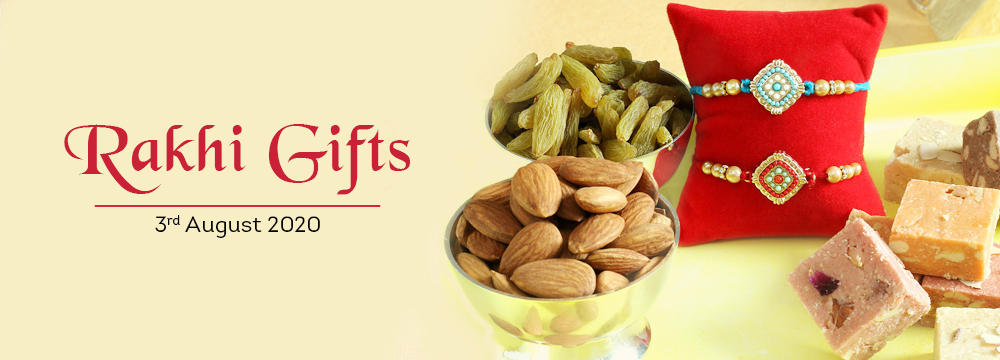

Rakhi festival is a day to celebrate and
cherish one of the most sacred relationships on this earth. The celebration
of Rakhi takes place amidst loads of gaiety and merriment.
 Every
year, this festival falls on the month of August or September according to
the English calendar.
Every
year, this festival falls on the month of August or September according to
the English calendar.
Rakhi Traditions
Traditions of Raksha Bandhan are centuries old and they have been followed
since ages with the same zeal and enthusiasm. People generally start
shopping for beautiful Rakhis nearly a month before the festival. Some
people also like to make Rakhi at home. Many brothers and sisters keep fast
on this day. Ladies cook delicious dishes and sweets for the day. After
taking bath early in the morning, they worship to God and seek his
blessings.
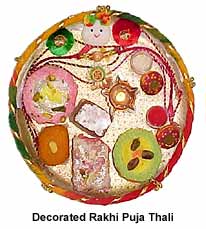
After worshiping to God, sisters decorate the puja thali and keep Rakhis,
rice particles, kumkum powder, diya and sweets on it. After doing aarti of
their brothers, they put tikka on the forehead of him and tie rakhi on his
wrist. Then they pray to God for long and prosperous life of their brother.
In turn, brothers promise to protect their sisters in every adversaries of
life. The ceremony of Rakhi tying follows with the exchange of beautiful
Rakhi gifts. As a token of love, these gifts memorialize this auspicious day
for many years to come.
The entire Hindu society have a strong believe in the tradition and custom
of this festival. The day of Raksha Bandhan is the emerald celebration of
love and affection which is enjoyed by every member of the family.
Rakhi Customs
With the spirit of unity in diversity, India celebrates rakshabandhan with
different hues and colors of love and affection. The rituals of Rakhi
festival has been there since ages. Known with different names in different
parts of the country, Raksha Bandhan is celebrated by following different
rituals in every region. Rakhi festival is known as Narial Poornima or
Coconut Full Moon in Maharashtra. This is because the coconuts are thrown
into the sea to appease the sea god, Varuna. It is religiously believed that
the three eyes of the coconut are the three eyes of Lord Shiva.
The festivity of the day not only indicates towards the bonding of sisters
and brothers but also affirms the belief in values and traditions. Avani
Avittam is another name given to the festival of Raksha Bandhan. This name
is well-known in Sounthern India. On this auspicious day, the brahmins take
out their Mahasankalpam or thread and wear new thread called Janeyu or
Yajnopavit. By offering libations of water they penance for their mistakes
which they have committed in past one year.